
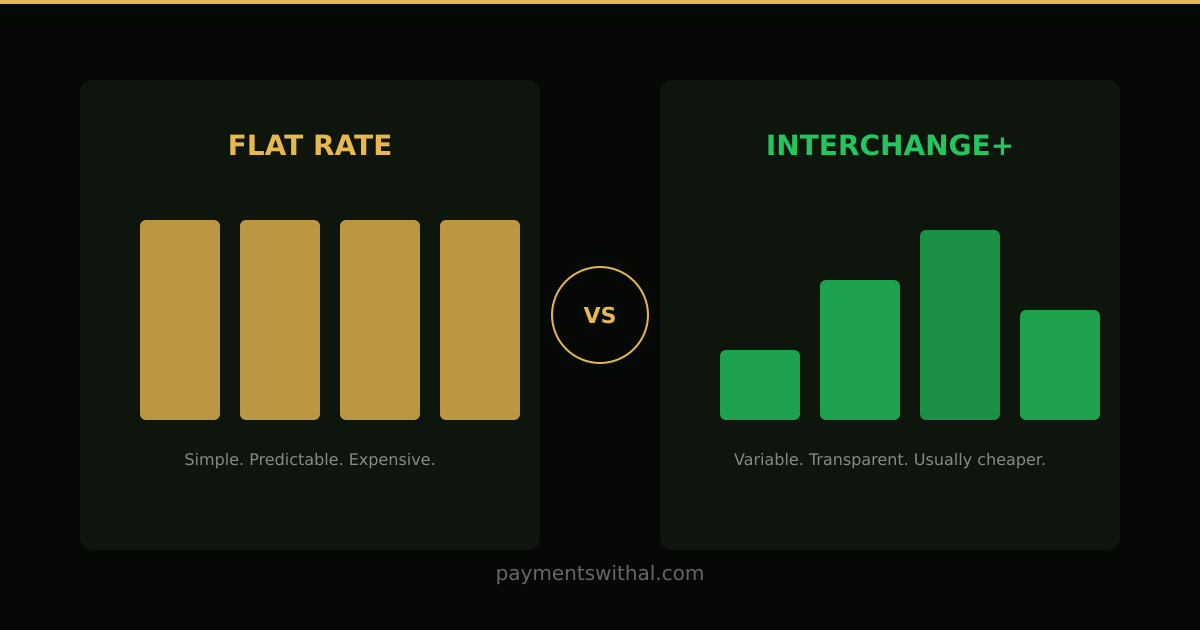
When you signed up for your payment processor, you probably agreed to a pricing model without fully understanding what it meant. That decision could be costing you hundreds or thousands of dollars a year.
There are two main pricing models you'll encounter: flat rate and interchange-plus. Understanding the difference — and the math behind each — is one of the most valuable things you can do for your bottom line.
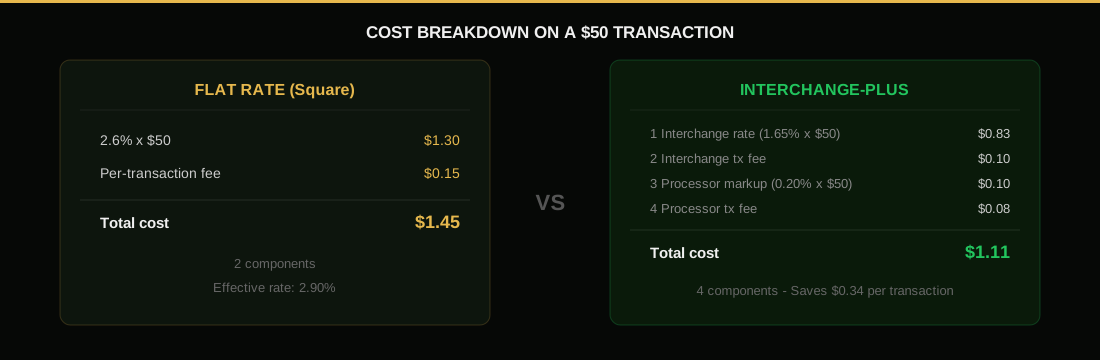
Flat rate pricing charges you the same percentage on every transaction, regardless of card type. Square charges 2.6% + $0.15 for in-person payments (tap, dip, or swipe) on their free plan, and bumped that per-transaction fee from $0.10 to $0.15 in October 2025. Stripe charges 2.9% + $0.30 online. Simple and predictable — but almost never the cheapest option for established businesses.
Interchange-plus pricing (also called cost-plus) charges you the actual interchange rate set by Visa and Mastercard, plus a fixed processor markup on top. Here's the part most processors don't explain clearly: interchange itself is a two-part fee. Every interchange rate has a percentage component AND a per-transaction fee. For example, a standard Visa rewards card might be 1.65% + $0.10. Add your processor's markup of 0.20% + $0.08, and your total cost on that transaction is 1.85% + $0.18.
That means on interchange-plus, you're paying four components on every transaction: the interchange percentage, the interchange per-transaction fee, the processor markup percentage, and the processor per-transaction fee. Most merchants don't realize they're paying two separate transaction fees — one to the card network and one to their processor.
Interchange rates span a wide range. Regulated debit cards (banks with over $10B in assets) are capped at 0.05% + $0.21 per transaction by the Durbin Amendment. Basic consumer credit cards run around 1.51% + $0.10. Standard rewards cards are typically 1.65% to 1.80% + $0.10. Premium cards — Visa Signature, Visa Infinite, Mastercard World Elite — can reach 2.40% to 3.25% + $0.10 for card-present transactions, and even higher for card-not-present — some premium card-not-present rates exceed 3.25%. The average across all card types is roughly 1.80%.
Now for the math that matters. On a $100 transaction with a rewards card under interchange-plus: 1.85% = $1.85, plus $0.18 in transaction fees = $2.03 total. Under Square's flat rate: 2.6% = $2.60, plus $0.15 = $2.75 total. Interchange-plus wins by $0.72 on a single transaction — that adds up fast at volume.
But flat rate has one scenario where it genuinely wins: very low average ticket sizes, typically under $5. Here's why. With interchange-plus, you're paying two per-transaction fees — one from the card network ($0.10 or more) and one from your processor ($0.05 to $0.15). Combined, you might be paying $0.18 to $0.25 in fixed fees before the percentage even applies. On a $3 coffee, those fixed fees alone represent 6–8% of the sale. Square's $0.15 flat fee is cheaper.
The break-even point shifts depending on your card mix. If most of your customers use debit cards, interchange-plus can save money even at moderate ticket sizes because debit interchange is so low. If you run a business where customers swipe premium travel rewards cards, the gap narrows.
How to switch: ask your current processor if they offer interchange-plus. Many do but default to flat rate because it's more profitable for them. If they won't offer it, that's a signal to shop around. And when comparing quotes, always ask for the combined effective rate — total fees divided by total volume — not just the advertised rate.