
Most merchants glance at their bank deposit, see a number, and move on. That gap — between what your customers paid you and what actually landed in your account — is where processors make their real money. And the gap is almost always larger than you think.
Your merchant statement is designed to be confusing. That's not an accident. The more line items there are, the harder it is to add them all up. By the time you've scrolled through a dozen fees, most business owners have already given up and gone back to running their business. That's exactly what processors are counting on.
This post is going to walk through every major fee category, show you real math on each one, and end with a straightforward way to calculate your true cost — your effective rate — so you can finally see what you're actually paying.
The Discount Rate: Your Starting Point, Not Your Ending Point
The discount rate is the headline number your processor sells you. It's the percentage taken from each transaction before the funds are deposited. If you're on a flat-rate plan like Square's in-person rate of 2.6% + $0.15 per transaction, that number is simple and everything is bundled in. You know exactly what you're paying.
But most small and mid-sized businesses aren't on flat-rate pricing. They're on tiered pricing or interchange-plus pricing — and those structures are a completely different story.
Tiered Pricing: Qualified, Mid-Qualified, Non-Qualified
On tiered pricing, your processor groups transactions into buckets: qualified, mid-qualified, and non-qualified. The 'qualified' rate is what gets advertised — it's the low number on the sales sheet. But the processor decides, largely on their own, which transactions qualify for that rate and which ones get bumped into the higher tiers. The criteria are often buried in the fine print or not disclosed at all.
In practice, a large portion of transactions — often 30% to 50% of volume for a typical retail business — end up downgraded to mid-qualified or non-qualified rates. The surcharges for those downgrades typically add 1.00% to 2.00% on top of your base rate. That's how a business sold a 1.65% rate ends up paying an effective rate of 2.50% or more.
Interchange-Plus: Transparent, But Still Multi-Part
Interchange-plus pricing is more transparent, but it's important to understand how it actually works. Interchange itself is a two-part fee: a percentage of the transaction plus a flat per-transaction dollar amount. For example, a common interchange rate might be 1.65% + $0.10 — both parts apply to every transaction.
On top of that, your processor adds their own markup — which is also two parts: a markup percentage and a markup per-transaction fee. So a full interchange-plus cost structure has four components: interchange percentage, interchange per-transaction fee, processor markup percentage, and processor per-transaction fee. A statement line like 'Interchange-plus 0.25% + $0.10' means the processor markup is 0.25% + $0.10, and the interchange cost is layered underneath that separately.
Interchange rates vary significantly by card type. A basic consumer debit card might come in at under 0.80%. A premium rewards credit card, especially in a card-not-present environment like e-commerce, can hit 3.25% or higher. That variability is real and legitimate — but on tiered pricing, you often don't see it itemized. You just see the downgrade surcharge.
Authorization Fees: Every Swipe Costs Money — Even the Declined Ones
Every time a card is presented for payment, an authorization request goes out to the card network. Your processor charges a fee for that request — whether the transaction is approved or declined.
Authorization fees typically run $0.05 to $0.15 per transaction. That might sound trivial, but volume adds up fast. A busy restaurant running 400 transactions a day at $0.10 per auth is paying $40 a day, $1,200 a month, or $14,600 a year — just from this single line item.
For lower-volume businesses, the math is less dramatic but still material. A retailer running 50 transactions a day at $0.10 per auth pays $150 a month, or $1,800 a year. You're paying this regardless of whether you ever see it called out clearly on your statement.
And again — declined transactions are charged too. If a customer's card is declined and they run it twice before giving up, you've paid for two auth fees on a transaction that generated zero revenue.
Assessment Fees: The Ones Most Merchants Miss Entirely
This is the fee category that catches almost every merchant off guard, even ones who've been in business for years. Assessment fees go directly to Visa and Mastercard — not to your processor. Your processor is simply passing them through, but how they're disclosed (or not disclosed) varies widely.
Current assessment fee rates:
Visa credit transactions: 0.13% of volume
Mastercard credit transactions: 0.1375% of volume
On $50,000 per month in Visa credit card volume, that's $65 per month in assessment fees alone — $780 per year — just from this one card network's cut. That's money going to Visa regardless of which processor you use, but many processors bundle it in ways that obscure exactly what's going to the network versus what's going to them.
Visa also charges additional fees that show up on statements and confuse merchants: a kilobyte (KB) fee for each authorization message transmitted, and a Digital Commerce fee on card-not-present transactions like online orders. These are small individually but present on virtually every statement for businesses that process online.
The practical implication: when comparing processor pricing, you need to separate network assessment costs from processor markup. Assessments are non-negotiable — every processor pays them and passes them through. What's negotiable is the markup on top.
Monthly and Annual Fees: Death by a Thousand Cuts
Beyond transaction-based fees, there's a layer of recurring fees that processors add for account maintenance, compliance, and services. These are often the most negotiable fees on a statement — and the most padded.
Statement Fee: $5–$15/Month
You're paying your processor for the privilege of receiving your own billing information. Statement fees run $5 to $15 per month and do exactly nothing for your business. They're pure margin for the processor. They're also completely negotiable — many processors will waive them if asked, especially for established accounts.
PCI Compliance Fee: $5–$30/Month or $75–$150/Year
The Payment Card Industry Data Security Standard (PCI DSS) requires any business that accepts card payments to maintain security compliance. Your processor charges a fee to administer this — usually $5 to $30 per month or $75 to $150 as an annual charge.
Here's the part that makes this fee particularly important to understand: if you are not PCI compliant — meaning you haven't completed your annual self-assessment questionnaire or whatever compliance steps your processor requires — many processors charge a non-compliance fee instead. That fee typically runs $30 to $100 per month. Non-compliance fees are automatic, ongoing, and easy to miss if you're not reviewing your statement carefully. Some merchants have paid non-compliance fees for years without realizing it.
The fix is straightforward: complete your PCI self-assessment. It takes an hour. But first, you have to know the fee exists.
Payment Gateway Fee: $10–$25/Month
If you process online transactions, you likely pay a separate gateway fee for the technology that connects your website to the payment network. This runs $10 to $25 per month and is in addition to your per-transaction costs. It's a legitimate fee for a real service — but it's worth knowing whether it's bundled into your effective rate or listed separately.
IRS 1099-K Reporting Fee: $5–$10/Year
Some processors charge an annual fee for filing your 1099-K form with the IRS — a form they are legally required to file regardless. This is one of the more cynical fees in the industry: charging you for a legal obligation they have to fulfill anyway. It's a small amount, but it's worth flagging because it reflects the broader philosophy of finding every possible billable line item.
Batch Fees: Charged Every Time You Close Out
At the end of each business day, most merchants close their batch — submitting all the day's transactions for settlement. Your processor charges a fee each time you do this. Batch fees typically run $0.05 to $0.30 per batch.
If you batch daily, that's 365 batches per year. At $0.30 per batch, that's $109.50 per year from this single line item. If your processor is on the lower end at $0.10 per batch, it's still $36.50 a year for the act of submitting your transactions.
Some processors batch automatically overnight, which can mean you're paying this fee without ever consciously doing anything. It's just there on the statement every month — 28 to 31 line items that add up quietly.
Non-Qualified Surcharges: Where Tiered Pricing Gets Expensive
This is the fee category that separates merchants who understand their statement from those who don't — and it's where tiered pricing extracts the most money from businesses that aren't paying attention.
On tiered pricing, your processor defines what counts as a 'qualified' transaction. Everything else gets downgraded. Downgraded transactions are charged a surcharge on top of your base rate — and those surcharges typically run 1.00% to 2.00% per transaction.
Here's what commonly causes a transaction to downgrade:
The customer uses a rewards credit card (points, miles, cashback) — these carry higher interchange, so processors push the cost onto you through a downgrade surcharge.
The customer uses a corporate or purchasing card — these have the highest interchange rates of any card category.
The card is keyed in manually rather than swiped, dipped, or tapped — card-not-present transactions are treated as higher risk.
The transaction is processed online — same card-not-present treatment.
The billing address provided doesn't match the address on file (AVS mismatch).
The batch isn't closed on the same day the transaction was authorized — a very common issue for businesses that don't batch daily.
The critical problem with tiered pricing is that processors are often not required to disclose exactly which transactions downgraded or why. You see a total non-qualified surcharge on your statement with no breakdown of what drove it.
Here's what that math looks like in practice: If 30% of your monthly volume downgrades and the non-qualified surcharge is 1.50%, that's effectively a 0.45% hidden surcharge on your total volume. On $50,000 a month, that's $225 per month — $2,700 per year — that didn't exist in the advertised rate you were sold.
Interchange-plus pricing solves this problem because there is no 'downgrade.' Every transaction is priced at its actual interchange rate plus your fixed markup. You can see exactly what every card type cost you. That transparency is the main reason interchange-plus is generally better for higher-volume businesses.
Chargeback and Retrieval Fees: You Pay Even When You Win
Chargebacks are a cost of doing business in card payments, but the fee structure around them isn't well understood by most merchants.
When a cardholder disputes a transaction with their bank, you receive a chargeback notice. Your processor charges a chargeback fee at that point — typically $15 to $100 per chargeback — regardless of the outcome. If you fight the chargeback and win, you don't get the fee back. You've paid it regardless.
Before a chargeback is formally filed, a bank may send a retrieval request — asking for transaction documentation (a receipt, a signed authorization, shipping confirmation) to evaluate the dispute before escalating. Retrieval requests typically cost $5 to $15 each. If you respond to the retrieval request and the matter is resolved without a chargeback, you've still paid the retrieval fee. If it escalates anyway, you pay both.
For businesses in high-chargeback categories — e-commerce, subscription services, restaurants, travel — these fees accumulate fast. And if your chargeback ratio (chargebacks as a percentage of total transactions) exceeds thresholds set by Visa and Mastercard, you can be placed in a monitoring program with additional fees and, ultimately, the risk of losing your merchant account entirely.
The practical advice here: document every transaction as thoroughly as your business model allows. For card-not-present transactions especially, collect billing address, CVV, and IP address at minimum. Respond to every retrieval request promptly. The cost of fighting a chargeback is often worth it not just for the transaction amount but to keep your ratio low.
Early Termination Fees: Read Before You Sign
Most merchant agreements are for a fixed term — often two or three years — with an early termination clause. If you cancel before the term ends, you owe an early termination fee.
The range is wide: $200 to $500 is common on the lower end. On the higher end, some contracts use a liquidated damages structure, which calculates the fee as your monthly minimum multiplied by the number of months remaining in the contract. If you have 18 months left at a $50 monthly minimum, that's $900. If the monthly minimum is higher, the number climbs fast.
Early termination fees are often buried in the middle of a multi-page processing agreement in language that doesn't call attention to itself. The processor's salesperson is incentivized to close the deal, not to walk you through the exit provisions.
Before signing any processing agreement, confirm: Is there a term? What is it? What is the ETF, and is it a flat fee or liquidated damages? Is there an automatic renewal clause, and if so, how far in advance do you have to provide notice of non-renewal to avoid it triggering?
These are not adversarial questions. Any processor worth working with will answer them directly. If they can't or won't, that tells you something.
How to Calculate Your True Cost: The Effective Rate
The effective rate is the only number that matters when you're comparing processors or evaluating your current processing costs. It's simple to calculate: divide your total processing fees for the month by your total processing volume for the month. The result is your effective rate.
Here's a complete example with realistic numbers:
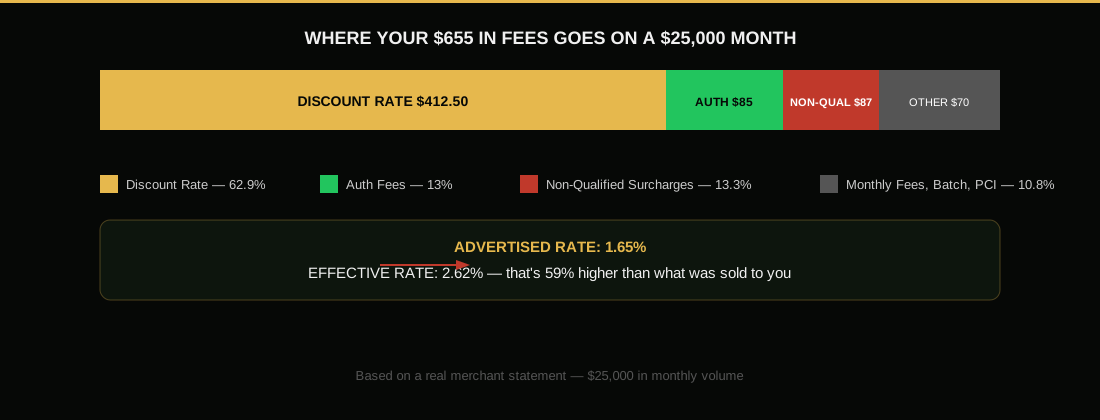
Monthly processing volume: $25,000
Discount fees (1.65% advertised rate): $412.50
Authorization fees (850 transactions × $0.10): $85.00
Assessment fees (0.13% on Visa volume): $32.50
Non-qualified surcharges: $87.50
Monthly account fee: $9.95
PCI compliance fee: $14.99
Statement fee: $7.50
Batch fee (26 batches × $0.20): $5.20
Total fees: $655.14
Effective rate: $655.14 ÷ $25,000 = 2.62%
The processor sold this account on a 1.65% rate. The actual cost is 2.62% — nearly 60% higher than the advertised number. That difference isn't fraud, and most of it is technically disclosed somewhere in the agreement. But it's structured to be difficult to see, which is not an accident.
For this business at $25,000 per month, the gap between the advertised rate and the effective rate costs $242.64 per month — $2,911 per year — beyond what the business owner thought they were paying.
What to Do With This Information
The effective rate is the only number that matters when comparing processors. A processor advertising 1.50% is not necessarily cheaper than one advertising 1.75% — because the advertised rate is almost never the full cost. The only valid comparison is effective rate against effective rate, calculated from real statements.
Most business owners who actually do this math are surprised by what they find. It's common to discover an effective rate that is 50% to 100% higher than what was presented at the time of signing. The fees discussed in this post are not hypothetical — they're on most merchant statements right now. They're just not organized in a way that makes the total easy to see.
Here's a practical starting point:
Pull your last three months of processing statements. For each month, add up every fee line — discount fees, auth fees, assessment fees, monthly fees, PCI fees, batch fees, statement fees, surcharges, all of it. Divide that total by your processing volume for the month. That's your effective rate.
If you're on tiered pricing and that number surprises you, your next question to your processor should be: what caused my non-qualified transactions, and why was I not informed about what triggers a downgrade? If they can't give you a clear answer, you have your answer.
If you're evaluating a new processor, ask them to calculate your effective rate based on your actual statement. Any processor serious about earning your business should be able to do this and show you exactly where the savings come from. If they won't, keep looking.
The payment processing industry is not going to simplify its fee structures on its own. The complexity is profitable. Your job as a merchant is to understand the structure well enough to ask the right questions and to know when the numbers don't add up.
Not sure where to start? Upload your statement and I'll walk through it with you.