
As card processing costs rise, more businesses are exploring ways to offset fees — or eliminate them entirely. Two common approaches are cash discounting and surcharging, but they work very differently and come with different rules.
Surcharging means adding a fee to credit card transactions above your regular price. Visa and Mastercard allow this, but with strict conditions: you must register with the card networks, the surcharge cannot exceed your processing cost (capped at 3%), you must disclose it at the point of sale and on receipts, and you cannot surcharge debit cards.
State restrictions on surcharging: as of 2026, most US states allow surcharging following the Supreme Court's ruling in Expressions Hair Design v. Schneiderman. A handful of states still have restrictions — check your state's current rules before implementing.
Cash discounting flips the model: your posted price includes the cost of card acceptance, and you offer a discount for cash payment. This is legal in all 50 states and does not require registration with card networks.
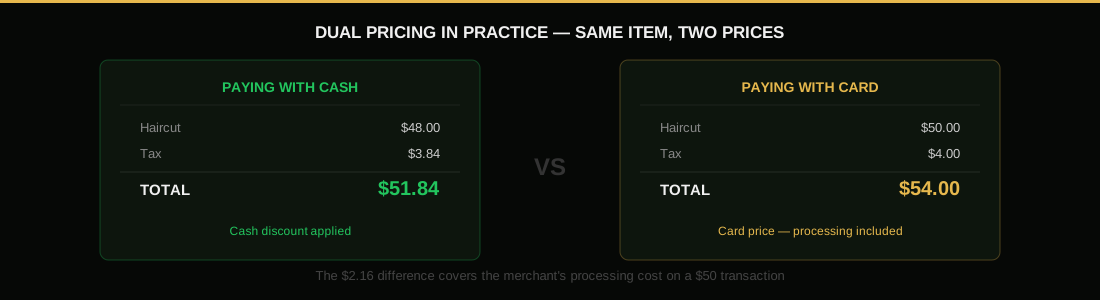
The practical difference: with surcharging, your listed price is the cash price and card users pay more. With cash discounting, your listed price is the card price (the higher price) and cash users pay less. The math can be identical, but the framing matters to customers and has different legal implications.
Dual pricing is a common implementation: display both a cash price and a card price on menus, tags, or at the register. Many POS systems now support this natively.
Does it make business sense? That depends on your customer base and how price-sensitive they are. Gas stations have done cash discounting for decades with little pushback. Restaurants have had more mixed results. High-end retailers almost universally avoid it to preserve perceived value.
The hidden cost of cash: cash is not free. Handling, counting, transporting, and depositing cash costs most businesses 1-2% of cash revenue when you factor in labor and armored courier fees. Some businesses that switched to surcharging discovered they were only saving 0.5-1% net.
If you're considering either program, run the math on your actual processing costs first, research your state's current laws, and consider how your customer base will respond. A small discount for cash at a hardware store is very different from a surcharge at a fine dining restaurant.