
You tap your card. The terminal beeps. A receipt prints. Transaction approved.
The whole thing takes about three seconds. But in those three seconds, your money passes through a chain of companies, networks, and systems that most business owners have never heard of — and every single one of them takes a cut.
If you’ve ever looked at your processing statement and thought “why am I paying this much?” — this is where it starts. Understanding the journey your customer’s payment takes is the first step to understanding what you’re actually paying for.
The Players Involved
Every card transaction involves five key parties. Most business owners only know about one or two of them:
- The Cardholder — your customer, the person tapping or swiping
- The Merchant — that’s you, the business accepting the payment
- The Issuing Bank — the bank that gave your customer their card (Chase, Capital One, etc.)
- The Acquiring Bank — the bank that holds your merchant account and receives the funds on your behalf
- The Card Network — Visa, Mastercard, Amex, or Discover — they set the rules and route the transaction
Your payment processor? They’re the middleman connecting you to the acquiring bank and the card networks. They’re the ones you signed a contract with, and they’re the ones adding their markup on top of everything else.
The 3-Second Journey, Step by Step
Step 1: Authorization
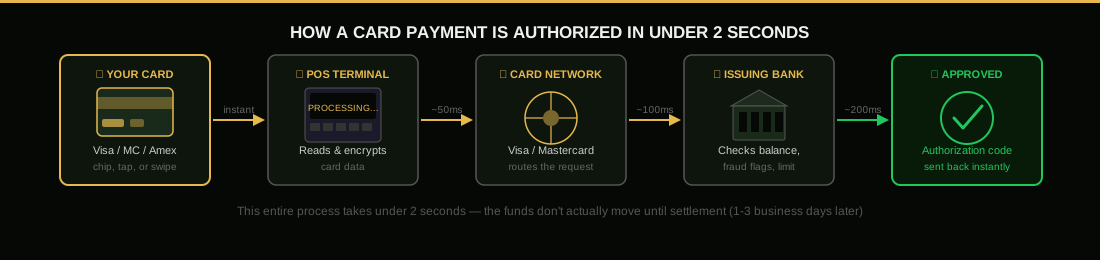
When your customer taps their card, the terminal sends an encrypted message to your payment processor. Your processor forwards it to the card network (Visa, Mastercard), which routes it to the issuing bank.
The issuing bank checks: Does this person have enough credit or funds? Is the card reported stolen? Does anything look fraudulent?
If everything checks out, the bank sends back an approval code. This whole round trip happens in about 1–2 seconds.
Important: At this point, no money has actually moved. The issuing bank has just placed a hold on the funds.
Step 2: Batching
Throughout the day, every approved transaction gets collected into a “batch.” At the end of the day (or at a set time), your terminal or POS system sends the entire batch to your processor for settlement.
Think of it like a deposit slip. You’re not depositing one transaction at a time — you’re sending the whole day’s worth at once.
Step 3: Clearing & Settlement
This is where the money actually moves:
- The card network distributes each transaction to the correct issuing bank
- The issuing bank transfers the funds (minus interchange fees) to the acquiring bank
- The acquiring bank deposits the funds (minus their fees and your processor’s markup) into your merchant account
This process typically takes 1–3 business days. That’s why you don’t see the money in your account the moment someone pays.
Where Your Money Goes: Interchange Explained
Here’s the part most processors don’t want you to think about. The biggest piece of what you pay in processing fees is called interchange, and it goes directly to the issuing bank — the bank that gave your customer their card.
Interchange isn’t a flat dollar amount. It’s a percentage of the transaction plus a fixed per-transaction fee. For example, a common Visa interchange rate for a regular consumer credit card swiped in person might be 1.51% + $0.10. On a $100 sale, that’s $1.61 going to the issuing bank.
But here’s where it gets complicated: there isn’t just one interchange rate. There are hundreds. The rate you pay depends on:
- Card type �� basic consumer credit, rewards card, corporate card, debit card. A basic Visa debit card might be 0.05% + $0.21 (regulated) while a Visa Signature Preferred rewards card could be 2.10% + $0.10
- How the card is accepted — swiped, dipped (EMV chip), tapped (contactless), or keyed in manually. Card-present transactions get lower rates because there’s less fraud risk
- Your business type (MCC code) — a grocery store pays different interchange than a law firm. Supermarkets, gas stations, and utilities get preferential rates
- Transaction data quality — sending additional data like tax amount, customer code, or invoice number (called Level 2/Level 3 data) can qualify B2B transactions for significantly lower rates
What Does the Average Business Actually Pay?
Across all card types and transaction methods, the average effective interchange rate in the U.S. falls roughly between 1.7% and 2.1% for credit cards. Debit cards are significantly cheaper — regulated debit (cards from banks with over $10 billion in assets, thanks to the Durbin Amendment) is capped at 0.05% + $0.21 per transaction. That’s just $0.26 on a $100 sale.
Here’s a realistic breakdown on a $100 credit card transaction:
- Interchange (to the issuing bank): ~$1.70–$2.10 — percentage + per-transaction fee, varies by card type and acceptance method
- Assessment fees (to the card network): ~$0.13–$0.15 — Visa charges 0.14%, Mastercard charges 0.1375%, plus small per-transaction fees
- Processor markup: varies wildly — this is the only part that’s negotiable, and the only part your processor controls
The first two — interchange and assessments — are non-negotiable. Every processor in the country pays the exact same rates. They’re set by Visa, Mastercard, and the issuing banks and are publicly available.
The processor markup is where the real story is. A fair processor on interchange-plus pricing might charge 0.10–0.25% + $0.05–$0.10 per transaction on top of interchange. A bad one? They’ll bundle everything into a flat rate like 2.9% + $0.30 and pocket the difference — which on many transactions is massive.
Why This Matters to Your Bottom Line
If you don’t understand this process, you can’t evaluate whether your processor is giving you a fair deal.
Here’s what I see all the time:
- Businesses on flat-rate pricing (like 2.9% + 30¢) paying way more than they need to, especially on debit transactions that should cost a fraction of that
- Processors burying junk fees in statements — PCI non-compliance fees, batch fees, monthly minimums, “regulatory” fees — that are pure profit
- Business owners who’ve never calculated their effective rate (total fees ÷ total volume × 100) to see what they’re truly paying
- Contracts with early termination fees that lock merchants in for years even when rates silently increase
The payment processing industry profits from confusion. The less you understand about interchange, assessments, and markup, the easier it is for someone to overcharge you.
What You Can Do Right Now
- Pull your last three processing statements and calculate your effective rate: total fees ÷ total volume × 100. If you’re above 3% on a mix of credit and debit, something is off
- Look at your debit transactions specifically — if you’re paying more than 1% on regulated debit, you’re subsidizing your processor’s profit margin
- Ask your processor what pricing model you’re on — if they can’t clearly explain it, or if your statement doesn’t show interchange separate from markup, that’s a red flag
- Compare what you’re paying to what interchange actually is — Visa and Mastercard both publish their full interchange tables online. The gap between published interchange and what’s on your statement is your processor’s real margin
Knowledge is the only real leverage you have in this industry. The more you understand about how the money moves, the harder it is for anyone to take more than their fair share.